FOLLOW US

CHICKPEA MOI MOI


       How to  prepare  CHICKPEA MOI MOI

Nigerian Moi Moi is a very delicous meal, so delicious that even those who do not like beans enjoy eating Moi Moi. But the No. 1 reason why lots of people do not like preparing Moi Moi in their homes is because the cooking process is long and laborious. All that peeling of beans, blending, chopping! Nobody has got time for that.

Chickpea Moi Moi to the rescue! It looks like beans Moi Moi, it feels like beans Moi Moi in the mouth and believe me it smells and tastes better than beans Moi Moi! Above all, it is easier to prepare than beans Moi Moi!
Yes, we can prepare Moi Moi with brown beans without peeling the beans but that's a whole story for another day because I have my reservations about that one.


Ingredients for Chickpea Moi Moi

I got about 10 wraps of Chick Pea Moi Moi with the following ingredients:
  • 1½ cups chickpeas
  • 1 habanero pepper (atarodo)
  • 2 sweet peppers (fresh paprika)
  • 1 big seasoning cube
  • 2 cooking spoons vegetable oil
  • 2 tablespoons ground crayfish
  • 2 teaspoons ground nutmeg
  • 1 onion
  • Salt (to taste)
  • Warm water (for grinding and mixing)

Notes on the ingredients

  1. Use dry chickpeas. Do NOT use canned chickpeas because they are already cooked.
  2. You can use chickpea flour to prepare Chickpea Moi Moi if that's all you have. I have a recipe where I used beans flour to prepare Nigerian moi moi , the directions on that recipe will work with chickpea flour. 
  3. Sweet peppers (fresh paprika) add a nice peachy colour to Chickpea Moi Moi. In Nigeria, use tatashe. Remember that tatashe is spicy so if you do not like spicy food, after adding tatashe, there may not be any need to add habanero pepper.
  4. When grinding the beans, use just enough water to help the blades of your blender rotate.
  5. For a delicious taste, use tasteless and odourless vegetable oils like the vegetable oils sold in Nigeria and sunflower oil. Do not use olive oil.

Containers you can use to cook the Chickpea Moi Moi


  • Aluminium foil bags. 
  • Uma leaves (Etere): used in the video below.
  • You can bake it in the oven.
  • You can use aluminium bowls.

Directions

  1. Rinse and soak the chickpeas in cool or lukewarm water for at least 3 hours or till you can cut the seed with your finger nails. You will also be able to peel it by rubbing it between your thumb and index finger. I soaked the one used in the video below for 6 hours.
  2. Pour the chickpea in a sieve to drain, after that pour in a bowl.
  3. Rinse, deseed and chop the sweet peppers to help your blender.
  4. Chop the onions and habanero pepper.
  5. Add the chopped sweet peppers, onions, habanero pepper, ground crayfish and seasoning cube (crushed) into the bowl of soaked chickpeas.
  6. Mix very well.
  7. Blend in batches with warm water till you get a smooth puree. For the quantity of water to use: when blending each batch, add water to just under the level of chickpeas in the blender. That quantity of water is usually the right quantity of water for mixing the Chickpea Moi Moi.
  8. Pour into a bowl. Add the oil and salt to taste.
  9. Mix very well and scoop into containers of your choice and cook in a steam pot. Watch the video below to see how I set up the pot of boiling water and a base to keep the wraps of Moi Moi away from the water while it cooked.
  10. For the quantity prepared in this recipe, I cooked it for 1 hour. For larger quantities, you will require a bit more time. If the water in the post dries up as you cook, add more water.
  11. When done, bring out the wraps of Moi Moi and spread on a tray to cool down to a comfortable temperature.

Serve while hot 🔥🔥
Serve with Jollof Rice, Fried Plantain e.t.c


Share:

OFE OWERRI

How to Prepare OFE OWERRI 

         Ofe Owerri is one of the most expensive Nigerian soups; it is made with assorted meat (which is different parts of cow meat), snails, dried fish and stock fish.
I think you would spend between 4000-10000 Naira if you are looking to make a delicious pot of this soup, there is even a popular Igbo song that suggest that a poor man does not eat ofe owerri. 😀

Ofe owerri simply means Owerri soup (soup indigenous to the people of Owerri). I used to think that I would never make another soup that would comfortably compete with the likes of nsala and oha but this sure takes the cake.

                     INGREDIENTS

- 1 kg assorted meats
- 2 medium size stockfish
- 2 medium dried fish(Asa)
- 1 tablespoon grounded pepper
- 2 tablespoon ground crayfish
- 2 cups Ukazi leaves (shredded)
- 2 small bunch ugwu
- 2 cups smoked prawns
- 1 small bulb onion
- 4 medium size cocoyam (red type)
- 2 cooking spoon palm oil
- 2 litres stock or water
- 2 maggi cubes 
- salt to taste

             COOKING DIRECTIONS

Pick, wash and shred the Ugwu leaves as well as the Ukazi leaves.(This can be done in the market)

Wash the meat thoroughly and place in a large pot. Season with salt,onion and ground pepper, add some water and cook for 10minutes or allow steaming till juice dries up.

Add 2 cups of water and the stockfish continue cooking till the stockfish is soft and the meat cooked. Wash and debone smoked fish and then dress and wash the smoked prawns. Add the fish and prawns to the meat pot and add the remaining water and cook for I0 minutes.

Peel and wash cocoyam, cut each into two pieces then add to the pot continue cooking until tender. Remove the cooked cocoyam and pound. Mould the pounded cocoyam into small balls and add to soup as a thickener. 

Stir in the crayfish,pepper, maggi cubes and palm oil. Stir thoroughly and reduce the heat. 

Add the shredded Ugwu and Ukazi leaves, stir and allow cooking for about 6 minutes. Stir and add salt to taste.

Remove from heat and serve hot with cassava fufu or pounded yam.♨♨♨


Share:

THAI SHRIMP SOUP

How to prepare THAI SHRIMP SOUP


        we declare this meal healthy and tasty! it is unbelievable though but we added the rice straight into the soup. this is a perfect thai bowl and every spoon is indeed promising. we challenge you to skip the take-out version and make this at home.
    

                      INGREDIENTS

450 g fresh shrimps
1 pc onion
1 pc lime
2 pcs garlic
1 tbsp ginger
2 tbsp butter
1 cup basmati rice
1 pc lime
1 can coconut milk
1 tsp salt
1 pc pepper
1 tsp black pepper
2 tbsp curry powder

                    COOKING DIRECTION

firstly, cook the rice according to instruction and set aside.

melt the butter in a small stockpot over medium-high heat. add the shrimp (peeled and deveined) then add the salt and pepper to taste.

cook, stirring occasionally for about 2-3 minutes or until pink. remove the shrimps and set them aside. then add the onion (diced), red bell pepper (diced) and garlic (minced) to the stockpot and cook until tender for about 3-4 minutes.

stir in the ginger until fragrant for about a minute. add the curry powder and stir to combine. gradually whisk in the coconut milk and 3 cups of vegetable stock. stir well for about 1-2 mintes and cook.

bring to boil then reduce the heat and allow to simmer until 8-10 minutes or slightly thickened.

stir in the rice, shrimps and squeeze in the lime juice. add cilantro (optional) and stir.

serve hot!♨♨♨


Share:

OFE - UJUJU

How to prepare OFE - UJUJU

       Ujuju soup has its origins in the Igbo speaking part of Delta State, Nigeria. This soup is very easy to make, the only hard thing about this recipe is the leaves itself. The leaves may be a little hard to find if you don’t live in the region and the leaves cannot be substituted with another vegetable, otherwise it won’t be Ujuju Soup anymore.. ☺

              INGREDIENTS

- 1½kg Bush meat
- 1 medium size Smoked fish
- 1 medium bunch Ujuju leaves
- 1 tablespoon Dried Pepper (ground)
- 3 cooking spoons Palm oil
- 2 Maggi Cubes
- 1½ litres Water
- Salt to taste.

                 COOKING DIRECTION

1). Scrub the bush meat and smoked fish with salt to remove sand.Soak in hot water for 5 minutes. Wash and debone the fish.Cut and wash the meat, add salt, Maggi cubes and chopped onion and steam for about 15 minutes till soft.

2). Pick the tender Ujuju leaves and remove the mid rib from all the leaves. Wash thoroughly and boil for about 10 minutes, strain and pound with or without oil (or blend or grind) to a smooth paste. Set aside.

3). Pour water into the pot, add the washed bush meat, smoked fish, pepper, Maggi, Crayfish stir and allow boiling for 10 minutes.

4). Add some oil and continue cooking for another 10 minutes. Stir and add the ground Ujuju leaves. Whisk to increase resilience.Keep pot open and simmer for few minutes and add salt to taste.

5). Serve with boiled white rice or pounded yam or eba. ♨♨♨

Share:

Creamy Spaghetti with Uziza Leaves

How to prepare Creamy Spaghetti with Uziza Leaves

           Uziza leaf is one leaf that turns most Nigerian soup from bland to spicy. And it did even better here by giving this meal a classy look and taste different from our everyday spaghetti. Enjoy this on days when your pillow isn't keeping you warm enough.
          

                  INGREDIENTS

- 300 g spaghetti
- 1 pc onion
- 1 pc tatase
- 5 pcs prawns
- 125 ml cooking cream
- 1 tbsp unsalted butter
- 1 tsp chilli powder
- 1 tbsp uziza leaf
- 1 pc seasoning cubes
- 1 pinch salt
- 1 pc tomato

                      DIRECTIONS

Devein the prawns and set aside. Roast the tatase over flame, allow to cook then deseed and chop into pieces. Also, chop the onions and uziza leaves and set aside. Note that the spaghetti used for this recipe is cooked.
Heat the butter in a medium saucepan. Saute the onion and tomato in the butter until the onion becomes translucent. Add the prawns and seasoning cube and cook on low heat until the prawns are cooked.
Add the uziza leaves and cream, and cook for about 2 minutes. Adjust seasoning with the chilli powder and salt.
Finally, stir in the tatase and spaghetti and allow to simmer for few minutes.
Serve hot.


Share:

PEANUT BUTTER SMOOTHIE

How to make PEANUT BUTTER SMOOTHIE

           Milkshake lovers, here is a great replacement that works at any time of the day. This gluten-free smoothie is perfect for breakfast on-the-go, afternoon snack and if you like your desserts in the evening, this will help cut down your calorie intake.

                   INGREDIENTS

*4 tbsp peanut butter
*1 cup coconut milk
*1 cup low fat yoghurt
*1 pc banana

                  DIRECTIONS

Peel the banana and put in a blender. Add the coconut milk, yoghurt and peanut butter to the blender and blend until smooth.
Serve in a glass or put in a refrigerator and allow it to chill before serving.

Share:

AVOCADO PASTA

 How to Prepare AVOCADO PASTA

         I have fallen in love with a creamy, flavorful pasta sauce that could not be easier to make. It's as simple as whirling a couple of ripe avocados, fresh herbs, and a drizzle of oil in a blender while your favorite pasta cooks. The avocado makes for an incredibly creamy mild base, while a generous amount of garlic and basil work together to give the sauce a punch of flavor similar to pesto, but without any cheese or nuts.
This pasta sauce is a game-changer for weeknight dinners, potluck pasta salads, and your work-day lunch box. Here's how to make it.

                    INGREDIENTS

12 ounces dry spaghetti or pasta

2 ripe medium avocados (about 6 ounces each), halved and pitted

1/2 cup lightly packed fresh basil leaves

1/2 cup lightly packed baby spinach leaves

2 cloves garlic

2 tablespoons freshly squeezed lemon juice

1 teaspoon kosher salt

1/4 cup olive oil
Optional for serving: Parmesan cheese shavings, cherry tomatoes, or chopped fresh basil leaves

               COOKING DIRECTIONS

1. Cook the pasta. Bring a large pot of salted water to a boil. Add the pasta and cook until al dente, 8 to 10 minutes, or according to package directions. Meanwhile, make the sauce.
2. Make the sauce. Scoop the avocado flesh into a blender. Add the basil, spinach, garlic, lemon juice, and salt. Blend until smooth, about 1 minute. With the blender running, drizzle in the olive oil and blend until incorporated; set aside.
3. Drain the pasta. Drain the pasta in a colander, then transfer to a large bowl.
4. Toss the pasta with the sauce. Pour the sauce from the blender onto the pasta and toss to coat. Serve immediately.

Recipe Notes
Storage: Leftovers can be stored in an airtight container in the refrigerator for up to 3 days, but the color may darken.

Share:

MIYAN KARKASHI

   How to prepare MIYAN KARKASH

     Are you looking for something different to cook this weekend? An arewa inspired classic, and very rich and nutritious? We have the answer. Miyan Karkashi is a delicacy popular in the North east and North central states, it can be prepared dry as per the leaves are dried and grounded into powder and used to thicken the soup or prepared wet like the Ewedu Soup. It can be served with tuwon shinkafa, tuwon dawa or tuwon masara. Here’s what you need to make this finger licking good soup;

                  INGREDIENTS

– 6 medium pieces of Beef (cooked)
– 1 medium size Dried Fish
– 3 medium size Fresh Pepper(ground)
– 2 bunches Karkashi
– 2 cakes Dadawa
– A Pinch of Potash
– I cooking spoon Oil (optional)
– One medium size onion
– 1½ Iitres of Water
– 2 maggi cubes, and salt to taste

              COOKING DIRECTIONS

Wash and season the beef with salt, steam for about 15 minutes.

Add the fish, ground pepper and onions, Boil for about 10 minutes.

Crush the karkashi as you pour into the pot and add the potash. Whisk lightly to create a fine consistency.

Add the ground dadawa, and cook for about 10 minutes. Add maggi cubes. Stir and add salt to taste.

Serve with tuwo of your choice.

Share:

GRILLED LAMB SIRLOIN WITH SALSA VERDE

How to Prepare GRILLED LAMB SIRLOIN WITH SALSA VERDE

               In South Africa, rump is used to describe the sirloin of a lamb, the tender strip of flesh connecting the leg to the loin. "While legs of lamb are more traditional at a braai," says Cape Town butcher Andy Fenner, "think of it like a large steak, with one lean side and one that's nice and fatty. The rump is more manageable, and just as tasty." Fenner scores the fatty side in a crosshatch pattern so the seasonings can penetrate deep into the meat. "Season it for 3 to 5 hours before cooking to draw the moisture out and get a good sear," he says. Then pair it with a fresh, acidic salsa verde.

For The Lamb: 

*Two 1-lb. boneless lamb rump (sirloin) roasts (do not trim) 
*Salt 
*Freshly ground black pepper

For the salsa verde: 

* ¾cup extra-virgin olive oil
*½ cup flat-leaf parsley leaves, finely chopped 
*¼cup fresh mint, finely chopped 
*Finely grated zest of 2 medium lemons (2 Tbsp.) 
*Juice of 1 medium lemon (2 Tbsp.) 
*1 tbsp. capers, drained and finely chopped 
*1 tbsp. minced anchovy fillets (from about 12 fillets) 
*2 tsp. Dijon mustard 
*2 cloves garlic, minced (1 tsp.) 
*¼tsp. cayenne pepper (optional) 
*Salt 

Directions: 

1. Prepare the lamb: Preheat a grill or grill pan to medium-high heat. Use a sharp knife to score the fat caps every inch; rotate the lamb 90° and repeat to form a crosshatch pattern. Season the meat generously all over with salt and pepper.

2. Transfer the lamb fat side down to the grill; cook until the fat renders a bit and the meat is well browned, about 4 minutes. (If flares occur, shift the meat away from the flame until it dies down, then replace.) Using tongs, turn the roasts and cook, turning occasionally, until browned all over and a meat thermometer inserted into the center reads 145° (medium-rare), 15–18 minutes more.

3. Remove the meat and let it rest for 15 minutes before thinly slicing and serving.

4. Meanwhile, make the salsa verde: In a small bowl, combine the oil, parsley, mint, lemon zest and juice, capers, anchovies, mustard, garlic, and cayenne (if using). Season with salt to taste and serve with the grilled lamb.


Share:

BRAISED EGYPTIAN GREENS WITH CRISPY CHICKEN (EGYPTIAN MOLOKHIA)

How to prepare BRAISED EGYPTIAN GREENS WITH CRISPY CHICKEN (EGYPTIAN MOLOKHIA)

              The name of this stew—named after the leafy green that’s used to make it—is one of Egypt’s most popular dishes. Molokhia, the grassy-tasting, green vegetable also known as jute or Jew’s mallow, is occasionally available fresh at farmer’s markets, but the frozen leaves are far easier to find. Look for them at Middle Eastern and North African grocery stores.
     

        Ingredients: 


*1 whole chicken, meat cut into 6 bone-in pieces, neck and ribcage reserved 
*1 large yellow onion, quartered 
*5 pods green cardamom, cracked 
*2 bay leaves 
*2 tsp. kosher salt, plus more to taste 
*2 tbsp. unsalted butter, softened 
*Freshly ground black pepper 
*About 2 tbsp. Cloves from 1 medium head garlic, minced to a coarse paste 
*1 tsp. fresh lemon juice, plus lemon wedges, for serving 
*1 tbsp. ground coriander 
*1 packet (15 oz.) frozen molokhia leaves, thawed and chopped if needed 
*3-4 cups cooked white rice, for serving. 

Directions: 

1. In a large, heavy-bottomed pot, add the chicken pieces and enough cold water to cover; bring to a boil over high heat. Reduce to medium-low and let simmer, skimming occasionally, 30 minutes. Add the onion, cardamom, bay leaves, and 2 teaspoons salt and continue to simmer until the chicken is fully cooked and tender, 20-30 minutes more. 

2. Meanwhile, preheat a broiler to high heat. Using tongs, remove the chicken pieces to a large baking sheet or oven-safe platter and set aside until cool enough to handle. Rub the pieces all over with 1 tablespoon butter, season with more salt and black pepper, and broil until the skin is browned, 4-6 minutes. Remove and set aside while you prepare the soup. 

3. Place a fine mesh strainer over a large bowl, and strain the stock (discard the solids). Measure out 5 ½ cups and set aside any remaining stock for another use.

4. In a medium pot, melt the remaining tablespoon butter over medium heat. Add the garlic, 1 teaspoon lemon juice, and the coriander. Cook, stirring occasionally, until very fragrant and the garlic is beginning to brown, 5-6 minutes. Quickly add the reserved 5 ½ cups stock and bring the mixture back up to a simmer. Add the molokhia, stirring to incorporate. Bring the mixture back up to a low boil, then simmer until the broth is smooth and slightly viscous and the garlic no longer tastes raw, about 5 minutes. (Take care not to overcook the soup, which will cause the leaves to fall to the bottom of the soup.)

6. Divide the rice among 6 individual bowls, then ladle in some of the hot stew. Top each with a piece of chicken and serve immediately with lemon wedges for squeezing.


Share:

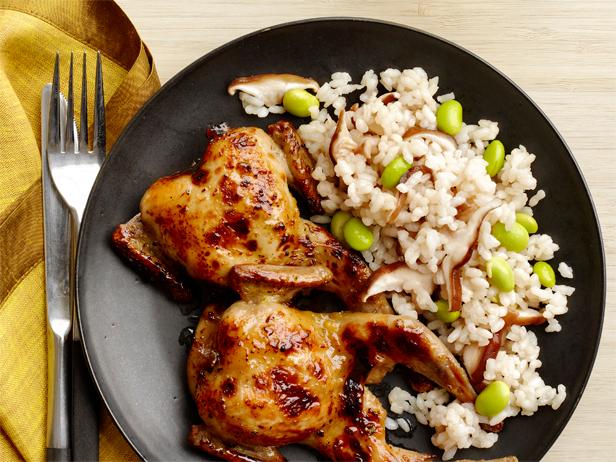
Grilled Quail With Miso

How to prepare Grilled Quail With Miso

          Grilled Quail With Miso might be just the main course you are searching for. This recipe serves 6. One serving contains 459 calories, 38g of protein, and 25g of fat . For $5.61 per serving, this recipe covers 25% of your daily requirements of vitamins and minerals. 1 person has made this recipe and would make it again. It can be enjoyed any time, but it is especially good for The Fourth Of July . Head to the store and pick up semi-boneless quail, sake, sugar, and a few other things to make it today. It is a good option if you're following a
gluten free and dairy free diet. All things considered, we decided this recipe deserves a spoonacular score of 68% . This score is solid. 

Ingredients: 

*3/4 cup white miso (soybean paste)
*1/3 cup sake
*3 tablespoons sugar
*4 scallions, white and light green parts only, chopped
*1 tablespoon vegetable oil
*12 semi-boneless quail (about 2 1/4 pounds)

Directions: 

Combine the miso, sake, sugar and scallions in a small saucepan over medium heat. Bring to a simmer and cook, stirring, until thick, about 5 minutes. Let cool, then transfer to a large bowl and whisk in the vegetable oil.

Pat the quail dry. Add to the bowl with the miso mixture and toss; cover and refrigerate 1 hour.

Preheat the broiler. Line a shallow baking pan with foil. Arrange the quail in the pan in a single layer. Broil, rotating the pan as needed, until the quail are browned in spots and cooked through, about 8 minutes per side.


Share:

Brunswick stew

How to prepare Brunswick stew

         Brunswick stew is a traditional dish, popular in the American South , generally involving a tomato base, local beans, vegetables, and originally small game meat, though today often chicken. The origin of the dish is uncertain, but it is believed to have been invented in the early 19th century. The states of Virginia and Georgia both make claims for originating the stew, in addition to claims of a German origin.

Ingredients: 

*4 tablespoons (1/2 stick) butter
*3 cloves garlic, minced
*1 large Vidalia onion, finely chopped
*One 15-ounce can fire roasted tomatoes (with their juices)
*4 cups homemade chicken stock
*1 1/2 cups barbecue sauce
*2 tablespoons Worcestershire sauce
*1 tablespoon light brown sugar
*1/4 teaspoon cayenne pepper
*1 1/2 pounds smoked pulled pork
*Half 16-ounce bag frozen corn kernels
*Half 16-ounce bag frozen baby lima beans
*Pinch salt and ground pepper
*Hot sauce, for serving
*Cornbread or soda crackers, for serving. 

Directions: 

Melt the butter in a large Dutch oven over medium-high heat. Once melted and foamy, add the garlic and onions and saute until soft, about 4 minutes. Stir in the tomatoes, chicken stock, barbecue sauce, Worcestershire, brown sugar, cayenne, smoked pork, lima beans, corn and a big pinch of salt and pepper. Bring the mixture to a boil, reduce to a simmer and cook over medium-low until thick and stewey, about 1 1/2 hours, stirring on occasion.

Serve with hot sauce, cornbread or soda crackers.


Share:

Ogbono Soup (Draw Soup)

How to prepare Ogbono Soup (Draw Soup)

          Ogbono Soup also known as Draw Soup makes eating Fufu Recipes so easy because of its slimy nature which helps the lumps of fufu slide down. If your kids do not like Okra Soup because of the chunks of Okra, then try Ogbono Soup, they will surely love it. You may want to use the recipe for light Ogbono Soup when preparing theirs.
            Some people like their Ogbono soup plain, with no added vegetables, others would not touch it unless there is some kind of vegetable in it. A third group love their
Ogbono Soup with Okra. Some people even go fancy and add Egusi to it.
Be sure to check out the following link where you'll find more tips for preparing Ogbono Soup.

             Ingredients for Ogbono Soup

*Assorted Meat and Fish: Beef, Shaki (cow tripe) , Dry Fish , Stockfish
*2 handfuls Ogbono Seeds
*3 cooking spoons red palm oil
*Vegetable: Frozen Spinach (you can also use Pumpkin leaves or even Bitterleaf)
*2 tablespoons ground crayfish
*Pepper and Salt (To taste)
*1 onion
*2 stock/seasoning/boullion cubes

Before you cook Ogbono Soup: 

1. Grind the Ogbono with a dry mill.

2. Cut the frozen spinach when it is not completely defrosted. It is easier that way. Then when completely defrosted, squeeze out the excess water.

3. Cook the assorted meat with the stock cubes and onion. If you will use Shaki, remember to start cooking that first, then add beef when almost done.

4. Grind crayfish and pepper.

5. Boil some water and set aside.

Cooking Directions for Ogbono Soup: 

1. Pour the palm oil into a clean dry stainless steel or aluminium pot. Set on the stove and melt the oil at low heat. Remember, only melt the oil, do not allow it to heat up.

2. Once melted, turn off the heat and add the ground Ogbono.

3. Use your cooking spoon to dissolve the Ogbono in the oil.

4. When all the Ogbono powder has completely mixed with the oil, add the meat/fish stock (water from cooking the assorted meat and fish). Set the heat of your cooker to low and start stirring. You will notice the Ogbono start to thicken and draw.

5. Keep stirring till the Ogbono has completely absorbed the meat stock.

6. Add a small quantity of the hot water and stir till the Ogbono has absorbed all the water. Repeat this process till you get a consistency

7. Making sure that your heat is set to low, cover the pot and start cooking. Once it starts to simmer, stir every 2-3 minutes for 20 minutes.
So what you'll do is: every 3 minutes or so, open the pot, stir every well, scraping the Ogbono that sticks to the base of the pot, cover the pot and cook for another 3 minutes.

8. After 20 minutes, the Ogbono should be well cooked and you will begin to perceive its nice flavour and aroma.

9. Add the assorted meat and fish, ground crayfish, salt and pepper to taste. The Ogbono may have become thicker from the cooking. If so, add a little bit more water and stir very well. Cover and cook till the contents of the pot is well heated up.

10. If you prefer your Ogbono Soup without vegetables, turn off the heat and serve but if you like to add a vegetable then keep reading :)

11. When the contents of the pot have heated up, add the vegetable . Stir very well, cover the pot and turn off the heat. Leave to stand for about 5 minutes and serve with any
Fufu recipe .

Serve Ogbono Soup with any Nigerian Fufu meal .


Share:

Nkwobi: Spicy Cow Foot

How to prepare Nkwobi: Spicy Cow Foot

         Nkwobi is a Nigerian delicacy that is usually ordered and enjoyed in exclusive restaurants.
         It is simply cooked cow foot mixed in spicy palm oil paste. Nkwobi is often mistaken for
Isi Ewu but they are not the same.

Ingredients for Nkwobi: 

*2kg (4.4 lbs) cow foot (cut into sizeable pieces)
*20cl (200ml) Palm Oil
*1 tablespoon powdered edible potash (Akanwu/Kaun/Keun)
*1 teaspoon ground Ehu seeds (Calabash Nutmeg)
*2 tablespoons ground crayfish
*2 habanero peppers (or to your taste)
*1 medium onion
*2 big stock cubes
*Salt (to taste)

To garnish: 

*1 medium onion
*10 Utazi leaves (Gongronema latifolium)

Notes on the ingredients: 

1. The 2kg of cow foot may sound like a lot but remember that cow foot is mostly bones so 2 people that love Nkwobi can finish that in no time.

2. Cow foot is quite tough so if you have a pressure cooker, do use it for cooking it to save time and gas/electricity. You may be able to buy calf foot which is softer and cooks in less time.

3. Ehu (Calabash Nutmeg) is a very traditional ingredient that is difficult to find outide Nigeria. If you can't buy it where you live, just prepare the Nkwobi without it. Ordinary nutmeg is not an alternative to this because they are not similar in any way. If you have friends or family in Nigeria, they will be able to buy ehu seeds and send to you, a small quantity goes a long way.

4. Potash is what makes the palm oil curdle as you will see in the video below. An alternative I know is what we call Ngu in Igbo. Ngu is even more traditional than potash so if you can't find potash, chances are that you won't be able to get Ngu either.

5. Utazi adds a nice bitter flavour to the Nkwobi. if you can't buy it where you live, use spinach (bold ones), it gives the same effect and actually tastes nice! 

Before you make the Nkwobi: 

1. Cut the cow foot into medium chunks. Where I live, the butchers cut it for me.

2. Put the powdered potash into a bowl. Add a small quantity of water (about 4 table spoons) and stir well.

3. Pass it through a fine sieve and set the liquid aside.

4. Cut 1 onion into 4 big chunks.

5. Pound the pepper with a mortar and pestle or blitz it.

6. Grind the crayfish.

7. Crack and remove the outer shell of the ehu then grind with a dry mill eg coffee grinder.

Directions for making Nkwobi: 

1. Wash and put the cow foot chunks in a pot.

2. Add the stock cubes (crushed) and the chunks of onion.

3. Add a small quantity of water and start cooking at medium heat till well cooked. Add just enough water to prevent burning as you cook. There should not be any stock (water) in the pot when the meat is done.

4. While the meat is cooking, pour the palm oil into a clean dry pot.

5. Pour in the potash mixture (sieved) into the oil.

6. Stir with a wooden spatula as you pour the potash. You'll notice the palm oil begin to curdle and turn yellow.

7. Keep stirring till all the oil has turned yellow.

8. Add the ground crayfish, pepper and ehu seeds. Stir very well till they are all incorporated.

9. When the meat is done, add salt, stir and cook till all the water has dried.

10. Add the well done cow foot to the palm oil paste and stir very well with the wooden spatula.

11. Put it back on the stove/cooker and heat till the Nkwobi is piping hot, stirring all the time to make sure it does not burn.

12. To prepare the garnish, cut the onions into rings and cut the utazi into long thin slices.

13. Serve the Nkwobi in a wooden mortar as shown in the image above.

14. Add the thin slices of utazi and onion rings on top for the full effects.

Best served with chilled drinks: palm wine, beer or stout and soft drinks.


Share:

Nigerian Isi Ewu: Spicy Goat Head


How to prepare Nigerian Isi Ewu: Spicy Goat Head

          The process of preparing Isiewu is so similar to that of Nkwobi that lots of people find it hard to differentiate between the two of them. One major difference is that Nkwobi is prepared with cow foot while Isi Ewu which literally means goat head, is prepared with goat head!

Ingredients: 

*1 Goat Head
*15 cl (150ml) Red Palm Oil
*2 teaspoons ground Ehu seeds (Calabash Nutmeg)
*1 tablespoon powdered edible potash (Akanwu/Kaun/Keun)
*2 big beef flavoured stock cubes
*2 medium onions
*About 10 Utazi leaves (Gongronema latifolium)
*2 habanero peppers (or to your taste)
*Salt (to taste)

To garnish the Isi Ewu: 

*1 onion
*About 10 Utazi leaves (Gongronema latifolium)

Notes on the ingredients: 

1. In Nigerian restaurants, the goat heads are cooked whole (without cutting them up) because they have a big pot where they can pile several goat heads and cook them at the same time. When preparing one goat head, it is not practical to cook it whole because you will need lots of water to get the goat head well cooked. And since we do not want lots of water in the meat when done, it is better to cut the isi ewu up before cooking it.

2. Goat meat is quite tough so if you have a pressure cooker, do use it for cooking it to save time and gas/electricity.

3. Ehu (Calabash Nutmeg) is a very traditional ingredient that is difficult to find outide Nigeria. If you can't buy it where you live, just prepare the Isi ewu without it. Ordinary nutmeg is not an alternative to this because they are not similar in any way. If you have friends or family in Nigeria, they will be able to buy ehu seeds and send to you, a small quantity goes a long way.

4. Potash is what makes the palm oil curdle as you will see in the video below. A healthier alternative is what we call Ngu in Igbo. Ngu is even more traditional than potash so potash is much more available. If you can't find potash, use baking soda, follow the instructions on Edible Potash Alternative for how to use it to make palm oil cuddle.

5. Utazi adds a nice bitter flavour to the Isi ewu. if you can't buy it where you live, use leafy spinach (bold ones), it gives similar effect and actually tastes nice! :))

Before you make the Isi Ewu: 

1. Cut the goat head into pieces making sure that the essential parts: ears, tongue etc are whole cuts that is, they are not cut into pieces.

2. Remove the brain and put in an aluminium foil bag then fold the bag to close just like with Nigerian Moi Moi. 

3. Wash the meat very well with foam and iron sponges where necessary, using a knife to scrape off the tough top skin especially on the tongue. There will also be traces of sooth from burning the fur off the goat, ensure that these are all cleaned.

4. Put the powdered potash into a bowl. Add a small quantity of water (about 4 table spoons) and stir well. Pass it through a fine sieve and set the liquid aside.

5. Cut the 2 onions into 4 big chunks.

6. Crack and remove the outer shell of the ehu then grind with a dry mill eg coffee grinder.

7. Pound the pepper with a mortar and set aside.

Directions for making Isi Ewu: 

1. Cook the goat head with the chunks of onion, the stock cubes and as little water as possible. Top up the water as necessary but make sure there is as little water as possible in the pot. This is because we do not want any stock in the pot when the meat is done. Remember to cook the brain too.

2. While the meat is cooking, slice the onion for garnishing into thin rings.

3. Cut half of the utazi into thin slices. Cut the other half into tiny pieces. The first will be used for garnishing while the latter will be added into the palm oil paste.

4. When the meat is done, remove the chunks of onion, take out the brain and mash it up till smooth.

5. Add salt, stir and cook till all the water has dried.

6. Set the meat aside to cool down.

7. Now, pour the palm oil into a clean dry pot.

8. Pour in the potash mixture (sieved) into the oil.

9. Stir with a wooden spatula as you pour the potash. You'll notice the palm oil begin to curdle and turn yellow. Keep stiring till all the oil has turned yellow. Use as little potash as possible because too much of it can upset your stomach.

10. Add the pepper, mashed brain, ehu seeds and the utazi that has been cut to tiny pieces. Stir very well till they are all incorporated.

11. Add the goat head to the palm oil paste and stir very well with a wooden spatula.

12. Put it back on the stove/cooker and heat till the Isi Ewu is piping hot.

13. Serve the Isi Ewu in a wooden mortar as shown in the image above.

14. Garnish with the thin slices of utazi and onion rings for the full effects.

Best served with chilled drinks: palm wine, beer or stout and soft drinks.


Share:

Advert

Photography

About Us

authorHello, my name is Jack Sparrow. I'm a 50 year old self-employed Pirate from the Caribbean.
Learn More →

Popular

Powered by Blogger.

Wikipedia

Search results

Latest News

Chicken and potato casserole

  Seasoned chicken and potatoes bake together in this incredible Loaded Chicken and Potato Casserole. It’s topped with bacon, cheese and gre...

Contact Form

Name

Email *

Message *

Post Top Ad

LightBlog

Search This Blog

Post Top Ad

Your Ad Spot

Archive

Post Top Ad

Your Ad Spot

Sponsor

test

Beauty

Comments

Recent Posts

Theme Support

Need our help to upload or customize this blogger template? Contact me with details about the theme customization you need.